


Categorías
Último blog
How Can OEM Clients Verify The True Lifespan Of Industrial American Type Light Duty Casters Before Purchasing?
Sep 15 , 2026
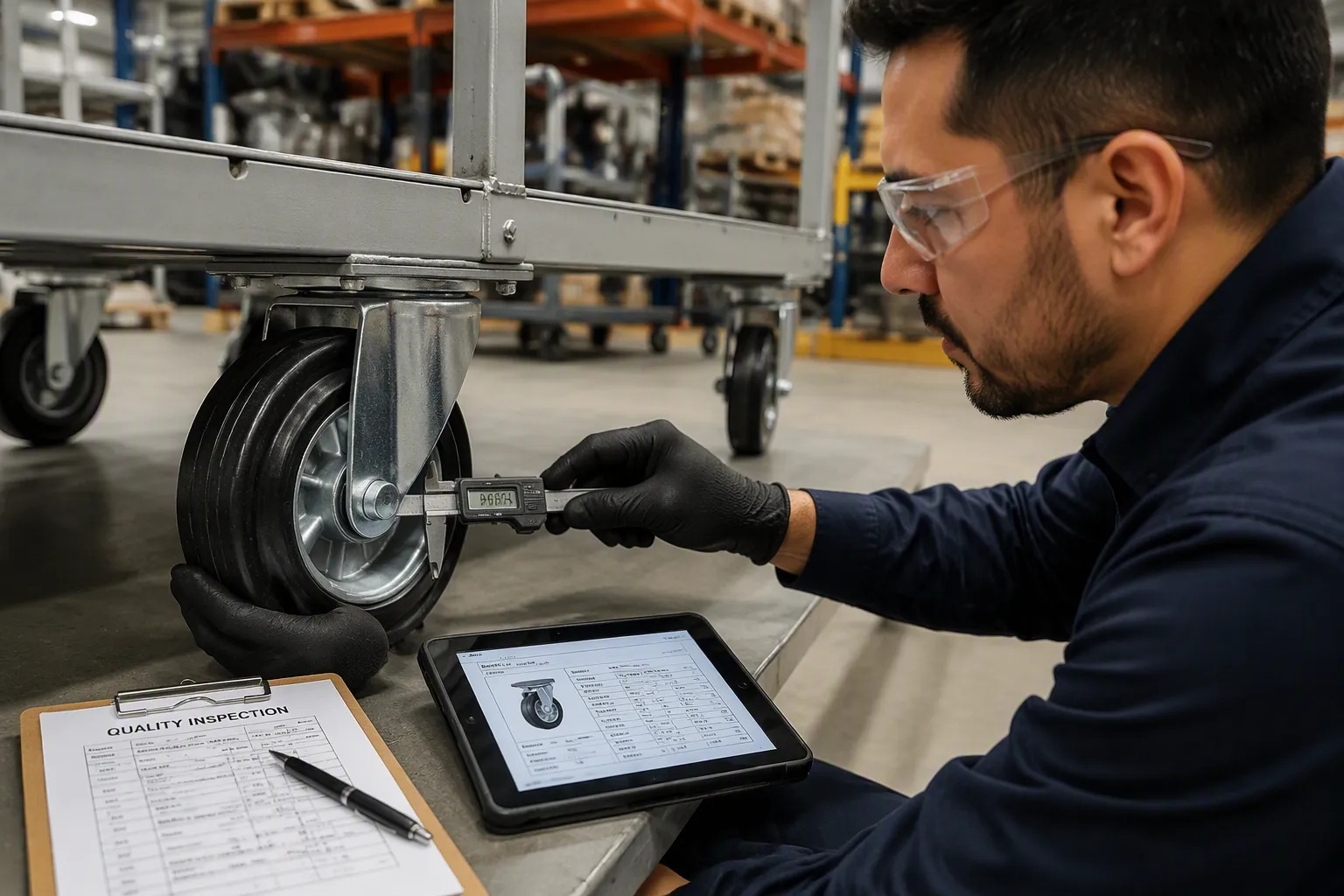
You can verify the lifespan of Industrial American Type Light Duty Casters by combining supplier audits, standardized test reports, third-party certifications, and sample testing. No single data point proves longevity. You must cross-check manufacturer claims against independent evidence. This structured evaluation protects you from inflated claims and costly field failures.
Cross-check test reports and material specs from your supplier against independent data to avoid inflated lifespan claims.
Use third-party certifications like SGS and ANSI/ASME to verify that casters meet reliable performance benchmarks.
Test samples in your own application and check warranty terms to confirm real-world durability and supplier confidence.
You cannot rely on a supplier's general marketing claims to judge lifespan. You need specific documents that show how a caster performs under controlled conditions. Test reports and material specifications give you the hard data to compare suppliers objectively.
Ask your supplier for a complete test report on the exact model you plan to buy. A general capability statement does not prove anything about a specific caster. The report should cover several test categories:
Static and dynamic load testing
Endurance testing
Brake cycle testing
Impact testing
Swivel testing
Salt spray (corrosion) testing
Temperature testing
Chemical exposure testing
Application-specific equipment testing
Look for recognized test methods in the report. EN12531 dynamic load testing is a common European standard. A quality caster should also pass a minimum of 10,000 brake operations and at least 48 hours of salt-spray testing. These thresholds separate durable Industrial American Type Light Duty Casters from low-cost alternatives.
The exact test report, rating, and acceptance criteria must be requested for the selected model; company capability statements are not substitutes for a model-specific result.
Compare the test conditions to your actual application. A caster that passes 10,000 cycles on a smooth concrete floor may fail quickly on a rough surface with debris. Ask the supplier to explain how their test setup mirrors real-world use.
The steel grade in the caster frame directly affects how long the product lasts. Lower-grade steel deforms under load and shortens service life. Request the exact steel specification from your supplier.
| Series | Steel Grade | Application Context |
|---|---|---|
| 95TRL | AISI 1045 drop-forged steel | Heavy-duty rugged applications |
| 90 | AISI 1045 drop-forged steel | Heavy-duty, deep-grooved raceway |
| 310 | AISI 1045 laser-cut steel | Superior strength, heat-treated |
| 410 | AISI 1045 laser-cut steel | Fully welded, kingpinless |
| 850 | AISI 1045 steel (3/4-inch thick) | Top plates, one-piece forging |
| 120 | 304 stainless steel | Kingpinless, maximum durability in corrosive environments |
| 330 | 304 stainless steel (rig), grade 316 swivel | Exposed to cleaning agents, marine environments |
AISI 1045 carbon steel offers excellent strength for general industrial use. AISI 304 stainless steel provides corrosion resistance for wash-down or marine environments. The wrong grade for your environment leads to premature failure.
Tread material also determines wear rate. Polyurethane and rubber behave very differently under load and in harsh conditions.
| Property | Polyurethane | Rubber | Influence on Wear & Lifespan |
|---|---|---|---|
| Abrasion Resistance | 3–5 times greater than rubber | Lower | Polyurethane lasts significantly longer in abrasive environments |
| Flat-spotting | Resists flat-spotting under static loads | Prone to flat-spots | Rubber wears unevenly, reducing lifespan; polyurethane maintains shape |
| Load Capacity | Supports 6–7 times the load of rubber at same size | Lower capacity | Polyurethane handles heavier loads without deformation, extending service life |
| Chemical Resistance | Impervious to oils, grease, solvents | Degrades quickly in oils | Rubber compound deteriorates faster in industrial settings, shortening lifespan |
| Typical Lifespan | Years in high-cycle manufacturing | Frequent replacement needed | Polyurethane offers better long-term value due to lower replacement rate |
Durometer (hardness) plays a critical role in tread lifespan. The right durometer depends on your load and floor conditions.
For polyurethane treads, the Shore A range also matters:
| Durometer Range | Performance Characteristics | Impact on Lifespan for Light Duty Casters |
|---|---|---|
| Soft (70A–85A) | Quieter, cushioned, ideal for delicate surfaces | Lower load capacity; may wear faster under heavy or continuous use, but protects floors well |
| Medium (85A–95A) | Balanced performance for general industry use | Good compromise between comfort and durability; suitable for moderate light-duty cycles |
| Hard (95A+) | Maximum load capacity and durability | Longest lifespan under heavy loads but less shock absorption; not typically needed for light duty unless high wear resistance is required |
The bearing assembly and raceway determine how smoothly the caster swivels and how long it lasts. A poorly finished raceway creates friction, heat, and premature wear. Ask for the raceway hardness and finish specification.
| Caster Series | Raceway Hardness | Finish |
|---|---|---|
| 8R-2-85 RWM Series | 53 Rockwell C minimum | Laguna Blue paint |
| 8M-GTB Muvtons Series | Induction hardened (uniform depth) | Bright Zinc Plated |
| 8D-R800 Darnell Series | Flame hardened (no specific rating) | Not provided |
A minimum hardness of 53 Rockwell C indicates a raceway that resists deformation under repeated swivel cycles. Induction hardening creates a uniform hardened depth, which provides consistent wear resistance. Flame hardening without a specific rating is harder to verify. Always request the actual hardness value.
Bearing type also matters. Precision ball bearings with hardened raceways outperform simple sleeve bearings in cycle life. Sealed bearings keep out dust and debris, which extends lifespan in dirty environments.
The rated capacity on a spec sheet means nothing without the test conditions. A caster rated for 500 pounds may only achieve that rating under ideal conditions. Ask these questions:
What load was applied during the test?
What speed did the caster travel?
What floor surface was used?
How many cycles did the caster complete?
What was the failure mode?
A caster that fails by raceway deformation at 8,000 cycles tells you something very different from one that fails by tread wear at 50,000 cycles. The failure mode reveals the weakest component. That information helps you predict real-world lifespan in your specific application.
You should also check whether the rated capacity includes a safety factor. Many manufacturers rate casters at 25% to 50% of the actual failure load. A higher safety factor gives you more confidence in the product's durability.
When you evaluate Industrial American Type Light Duty Casters or a specialized Shock Absorbing PU Cast Iron Core Wheel Functional Castor, compare test reports across multiple suppliers. Look for consistent test methods and transparent data. A supplier who shares detailed test results demonstrates confidence in their product. A supplier who avoids specific numbers may have something to hide.
Image Source: pexels
A supplier's internal test reports provide useful data, but you need independent verification. Third-party certifications remove bias from the evaluation. They confirm that Industrial American Type Light Duty Casters meet recognized performance benchmarks.
Start by looking for certifications from respected testing organizations. SGS certification involves third-party testing for assured reliability. Destructive life cycle testing under SGS confirms real-world durability of 1 to 3+ years.
Industry standards also define minimum requirements. ANSI-ICWM standards require a brake holding force of at least 20% of the rated capacity. The same standards mandate that brake mechanisms survive 5,000+ engagement cycles during fatigue testing. Verify that your supplier meets these thresholds.
ANSI and ASME standards cover caster design, load ratings, and safety factors. A supplier who claims conformance should provide documentation proving that claim. Ask for the specific standard number and conformance date.
A certification on one caster model does not cover another. Request documentation listing the exact model number you plan to purchase. Check the expiration date as well. Expired certifications have no value.
Raw material quality directly affects caster lifespan. Batch numbers link finished parts to specific material lots. Documentation should provide complete chemical analysis, not just an alloy designation. Request Mill Test Reports that link each batch to certified raw material sources. Each incoming batch should receive spectrometer verification to confirm chemistry matches specifications. This traceability system prevents failures caused by substandard alloys. Complete documentation supports consistent quality and reduces the risk of premature failure.
You should test samples under conditions that simulate your actual application. Accelerated life testing compresses months of wear into weeks. Load the caster beyond its rated capacity, run it over rough surfaces, and cycle it through thousands of swivel rotations. Document every failure point. This hands-on approach reveals weaknesses that spec sheets hide.
Ask your supplier for performance data from customers with similar equipment and floor conditions. Real-world results carry more weight than laboratory numbers. A caster that lasts three years in a warehouse may fail in six months on a loading dock. Match the reference application to your own use case as closely as possible.
A strong warranty signals supplier confidence. Shepherd Casters offers a 3-year warranty on its light-duty products. Faultless Caster provides an industry-leading 3-year warranty on many products. These terms double or triple standard competitor coverage. However, you must read the exclusions carefully. Common exclusions include:
Damage from misuse, overloading, improper installation, or modification
Normal wear and tear, including tread wear and corrosion
Damage from chemicals, extreme temperatures, or improper flooring
Products that have been altered, modified, or repaired
Request CAD files for every Industrial American Type Light Duty Casters model you evaluate. Check the mounting bolt pattern against your equipment frame. Verify the swivel radius clears all obstructions through the full rotation. Confirm the overall height fits your design envelope. CAD review catches fit problems before production. It also helps you trace the load path from the wheel contact patch through the frame.
You must verify the lifespan of Industrial American Type Light Duty Casters by combining documentation review, material analysis, third-party certification, and hands-on sample testing. A data-driven approach, not supplier assurances, is the only reliable method to confirm true lifespan. Building verification into your sourcing process reduces risk, avoids rework, and protects your end-product reputation.
You must cross-check internal test reports with third-party certifications and your own sample testing. No single data point provides complete validation.
Dynamic load and cycle test data from standardized methods like EN12531 reveals real-world durability. Always verify test conditions match your application.
Certifications remove bias from the evaluation. They confirm independent verification of performance benchmarks like ANSI/ASME standards.