

Categorías
Último blog
How Can Engineers Minimize Rolling Noise With Thermoplastic Rubber (TPR) Caster Wheels?
Oct 26 , 2026
TPR caster wheels minimize rolling noise through high internal damping, soft tread hardness, and vibration absorption at the wheel-floor interface. You also need the right bearings, swivel design, and maintenance for quiet operation. Combine TPR wheels with targeted component optimization, including customizable caster single wheels, and you achieve measurably quieter performance.
Rolling noise starts at three points: the wheel-floor contact, the bearing and swivel assembly, and the frame that carries the load. You can trace almost every unwanted sound back to one of these sources.
Every surface irregularity sends energy into the wheel. Floor condition shapes the noise profile as much as wheel material does.
| Floor Feature / Condition | Effect on Caster Noise |
|---|---|
| Expansion joints, cracks, grates | Cause impact spikes regardless of wheel type; softer treads mask them better |
| Micro-joints and seams | Absorbed by high-elasticity soft rubber/neoprene (quietest, ≤46 dB) |
| Floor joints (general) | Rigid phenolic/hard plastic produces a sharp "tick" at every joint (60–68 dB) |
| Tile/terrazzo expansion joints | Nylon/glass-filled nylon yields pronounced "clack-clack" and structure-borne noise (65–75 dB) |
A resilient tread bonded to a rigid core absorbs surface irregularities while the core carries the weight. Tread compliance absorbs impacts at expansion joints and thresholds that a rigid wheel transmits straight into the frame and load. Rubber and TPR are the quietest tread materials, with polyurethane close behind; hard materials such as nylon, phenolic, steel, and cast iron transmit floor texture directly into the equipment frame, which is what produces the noise.
Bearings convert rolling motion into small vibrations. Worn races, loose fits, and dry lubricant amplify those vibrations into audible hum and rattle. Swivel mechanisms add another path: a loose kingpin or worn raceway lets the fork chatter during direction changes.
The frame acts as a sounding board. Thin housings and large unsupported panels pick up vibration from the wheel and radiate it as noise. Rigid, well-damped housings keep that energy contained.
Image Source: pexels
You now understand where rolling noise originates. The next step is to examine how TPR wheels and the components around them suppress that noise. Each design decision—from the rubber compound to the bearing type—plays a distinct role in the final acoustic result.
Internal damping describes how well a material converts mechanical vibration into heat instead of sound. TPR excels at this conversion. The material's molecular structure absorbs impact energy and dissipates it before it reaches the frame.
You can compare damping performance across common wheel materials in the table below.
| Material | Shock Absorption (Damping Indicator) |
|---|---|
| Standard Rubber | Excellent |
| Polyurethane (PU) | Fair |
| Thermoplastic Rubber (TPR) | Good |
| Nylon | N/A (not addressed in source) |
TPR delivers the cushioned, quiet ride associated with rubber while absorbing shock well and resisting chemical degradation. Rubber is framed as offering superior acoustic dampening and heavy cushioning, whereas PU is framed as prioritizing load capacity and abrasion resistance over cushioning. TPR is positioned as bridging the gap between rubber's cushioning and PU's durability.
This balance matters for engineers. You get rubber-like quietness without sacrificing the durability that polyurethane offers. The damping behavior of TPR keeps vibration energy from traveling into the caster fork and equipment frame.
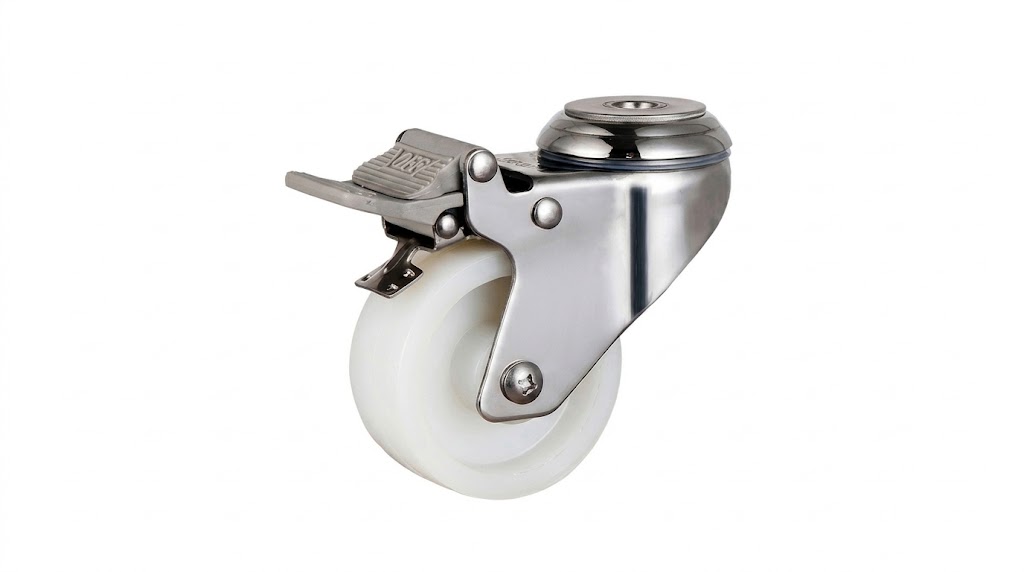
Medium-duty SS nylon swivel caster features a TPR tread where elasticity complements damping. The tread flexes under load and recovers its shape after each contact with the floor. This elastic recovery smooths the transition over small obstacles, allowing the wheel to maintain contact with the surface instead of bouncing. Consequently, this eliminates the repetitive impact noise that hard wheels generate.
Tread hardness determines how much the wheel conforms to the floor. A softer tread flexes over bumps and dips. A harder tread transmits every surface irregularity as impact noise.
Soft tread materials such as rubber, TPR, and polyurethane reduce caster noise on uneven floors because they flex and conform to the floor surface just enough to soak up vibrations. When a wheel rolls over bumps or dips, a hard wheel transmits the impact as sharp clattering, but a conforming soft tread absorbs those shocks and muffles the sound. This is why rubber is described as the quiet standard and softer TPR and polyurethane wheels are recommended over metal or hard nylon for noisy, uneven surfaces.
Hard casters generate significant noise on hard floors, ranging from clicking to loud clattering. Noise from hard casters increases with floor damage, uneven surfaces, or debris. These conditions underscore why conforming soft treads are preferred for uneven floors.
You should match tread hardness to your specific floor conditions. A TPR compound with a Shore A hardness in the 70–85 range handles most indoor commercial environments well. Softer compounds suit tile and terrazzo. Slightly harder compounds work better on concrete with expansion joints.
Material selection involves trade-offs. You need to weigh noise reduction against load capacity, floor protection, and durability. The comparison table below summarizes these trade-offs.
| Material | Load Capacity | Noise Level | Floor Protection | Durability | Cost |
|---|---|---|---|---|---|
| Polyurethane | Medium–High | Low | Very good | High | Medium |
| Nylon | Very high | High | Poor | Very high | Medium |
| Rubber | Low–Medium | Very low | Excellent | Low | Low |
| TPR | Low–Medium | Low | Very good | Medium | Low–Medium |
TPR is positioned between polyurethane and rubber. It runs quieter than urethane and is more durable than pure rubber. In equivalent wheel sizes, its load capacity is notably lower than polyurethane. Using a softer compound on a similar hub, TPR trades some load rating for reduced noise.
Consider these specific comparisons when you specify wheels.
TPR wheels are also much more economical than traditional hard and soft solid rubber wheels. They perform better and offer quieter mobility at a lower cost. TPE wheels, an advanced alternative to standard TPR, offer superior debris rejection, shock absorption, floor protection, durability, and load ratings. TPE costs a little more than standard TPR. Material innovations in TPR formulations improve durability and extend service life, which reduces maintenance costs. Fillers such as carbon black or silica and bio-based additives strengthen the compound. Process improvements—automation, precision molding, extrusion, and injection and blow molding—streamline production, reduce waste, and enable high-volume manufacturing with consistent quality and faster prototyping. Digital tools such as CAD and FEA allow you to optimize wheel structures, yielding lighter, more resilient wheels that absorb shocks better. Together these factors imply lower long-term ownership and production costs.
Customizable caster single wheels give you direct control over noise generation at the tread. Tread block and groove arrangement influences the noise a wheel generates while rolling. Quieter designs use patterns that disrupt airflow, which reduces noise generation.
Tire noise is caused by air compressing and releasing inside tread grooves as the wheel rolls. Quieter designs are often symmetrical. Manufacturers vary tread block sizes and shapes through variable pitch design to break up sound waves coming off the wheel. Aggressive patterns with large, chunky blocks often produce more noise, perceived as a hum at higher speeds.
| Tread Pattern Type | Design Description | Noise-Related Outcome |
|---|---|---|
| Rib type | Tread and grooves run along the wheel circumference | Relatively low noise generation |
| Rib-block type | Block tread in the center combined with a shoulder rib design | Relatively low noise generation |
You can specify customizable caster single wheels with rib or rib-block patterns for the quietest operation. These patterns work well for carts that travel long, straight routes in hospitals, offices, and retail spaces. Customizable caster single wheels also let you tune tread width and profile to your load distribution. A wider tread spreads contact pressure and reduces the depth of floor deflection. Customizable caster single wheels with optimized profiles maintain a near-perfect circular shape, which eliminates travel-path bumps that cause impact noise.
Precision machining of roller surfaces minimizes geometric irregularities that cause impact noise. Optimized bearing structures reduce friction-induced acoustic emissions. Material selection favors elastomers and thermoplastics with good damping properties. Strategic lateral motion at 90-degree travel angles reduces vibration in vibration-sensitive applications. TPR rollers provide good damping and can be paired with brass bushings or other bearing interfaces, balancing durability and noise reduction.
Bearings are the second major noise source after the tread. The bearing type you choose determines how smoothly the wheel rotates and how much vibration reaches the frame.
Sealed precision ball bearings offer the highest noise reduction. The seal keeps contaminants out and retains lubricant. You should specify sealed precision ball bearings for noise-sensitive environments such as hospitals, laboratories, and cleanrooms.
Lubrication sustains low noise levels over time. Dry bearings produce a characteristic hum and rattle. Apply machine oil to ball bearings monthly. Apply lithium grease to roller bearings every 90 days. Avoid thick lubricants that attract dirt and debris. If bearings remain rough or show damage after lubrication, replace them with sealed bearings.
The swivel mechanism and housing complete the noise path. A precision swivel mechanism is engineered for applications that demand high performance, low noise, and minimal resistance. Its key noise-reducing feature is the use of sealed precision bearings, which deliver smoother operation and reduced noise while remaining durable under frequent use and heavy loads. Precision swivel mechanisms are recommended for noise-sensitive environments and are used in diagnostic equipment and cleanroom carts. Choose precision swivel mechanisms when you require quieter operation.
In the medical industry, swivel casters are used on equipment such as X-ray machines to reduce noise, enhance maneuverability, and prevent injuries to health workers.
Housing material and construction also influence noise transmission. A polyurethane tread over an iron hub provides quieter operation versus solid iron while retaining load-bearing strength. The iron hub gives you strength. The polyurethane tread gives you noise reduction and floor protection. This combination works well for heavy-duty applications that still require quiet operation.
Nylon and polypropylene wheels provide chemical resistance and quiet movement, making them common in laboratories and clean rooms. Precision bearings in swivel casters are used on hospital beds, IV stands, and medical carts to achieve smooth, noise-free mobility. Low-noise rubber casters create a quiet, smooth rolling experience, as used on retail and office furniture such as shopping carts and office chairs.
Maintenance practices sustain low noise levels throughout the caster's service life. Follow these steps.
For cleaning, remove debris from wheels using a cloth or compressed air. Use a toothbrush to scrub stubborn buildup around the bearings. Clean the wheel surface and mounting hardware as well. Apply a silicone-based lubricant or light machine oil to the bearing race and axle. If bearings remain rough or show damage after lubrication, replace them with sealed bearings.
| Maintenance Task | Frequency / Guidance |
|---|---|
| Clean wheel assemblies | Weekly |
| Lubricate ball bearings | Monthly with machine oil |
| Lubricate roller bearings | Every ~90 days with lithium grease |
| Check bolts and hardware | Inspect for looseness; apply thread locker to prevent rattling |
| Test swivel action | Should be smooth, not sticky |
| Replace seals | Replace any seals letting in dirt |
| Replace worn treads | When more than 25% thinner than new |
You can measure noise to verify your maintenance program works. Take readings at worker ear height along cart routes—loading docks, corners, and high-traffic stretches—during both busy and slow periods. Log the readings in maintenance records to detect noise trends.
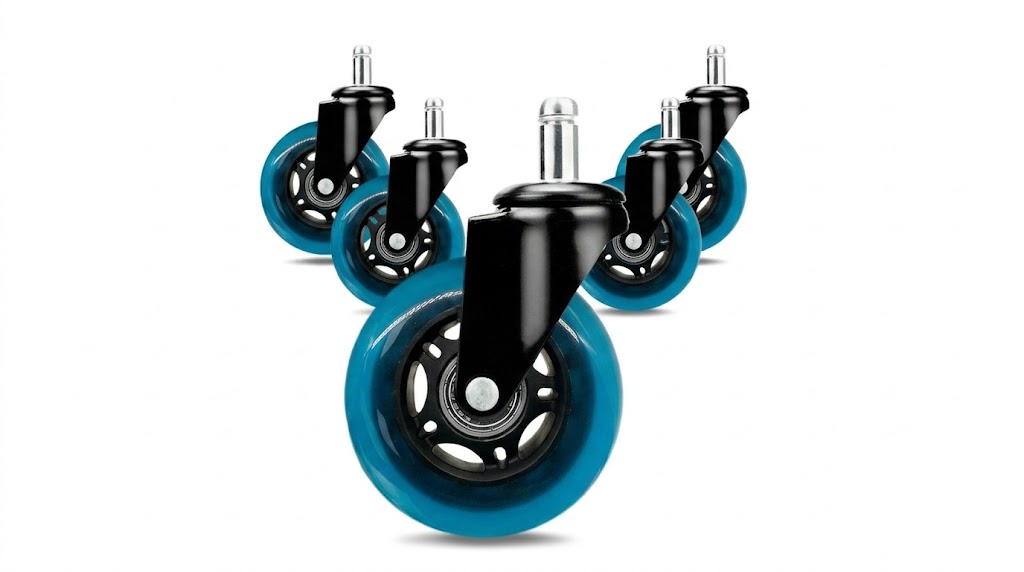
Blue Transparent PU Material Swivel Furniture Caster Wheels deliver smooth, quiet mobility, but their longevity relies on proper usage. Hands-on training programs teach operators wheel maintenance, load balancing, and careful steering to reduce noise. Furthermore, regular inspections help identify worn parts—wheels, bearings, and dampening components—before they become noisy. We recommend setting a schedule to replace them proactively to ensure your furniture always glides silently.
TPR wheels attack rolling noise at its source. Material damping and surface conformity absorb vibration before it becomes sound. Pair them with precision bearings, rigid housings, and routine maintenance for the quietest results. Treat noise reduction as a system-level design decision, with TPR wheels as your foundation.
A: Choose a 70–85 Shore A compound for most indoor floors. Softer compounds quiet tile and terrazzo. Slightly harder compounds suit concrete with expansion joints.
A: Specify sealed precision ball bearings. They keep contaminants out, retain lubricant, and deliver the smoothest rotation. Sleeve bearings work for lighter duty, but they demand more frequent lubrication.
A: Take sound level readings at worker ear height along your cart routes. Log the results in maintenance records. Rising readings signal worn treads or dry bearings that need attention.