

Published: August 28, 2026 | Updated: August 31, 2026
What Are Industrial Casters
Direct Answer
Industrial casters are wheel-and-bracket assemblies engineered to move equipment, carts, racks, machinery and material-handling systems in workplaces. Compared with basic furniture casters, they are specified for measurable load, duty cycle, floor obstacles, speed, impact, environment, mounting and control. Industrial casters may be swivel or rigid, plate- or stem-mounted, braked or unbraked, and fitted with polyurethane, rubber, nylon, phenolic, cast-iron, steel or specialized wheels. “Industrial” is not one universal capacity class. Buyers must verify the exact model’s dynamic rating, dimensions, materials and test conditions for manual, tow-line, washdown, high-temperature, medical, warehouse or OEM service.
Quick Reference Data Table
| Industrial requirement | Why it matters | Evidence to request |
|---|---|---|
| Dynamic capacity | Moving loads, joints and turns create more stress than static support. | Model rating and test method |
| Duty cycle | Distance, starts, turns and idle time affect heat and wear. | Application profile and cycle test |
| Floor interaction | Tread changes push force, noise, marking and damage. | Material data and loaded trial |
| Mounting strength | Plate, bolts, welds and frame form one load path. | Drawing, fastener specification and inspection |
| Steering control | Layout determines maneuverability and tracking. | Cart layout review and route trial |
| Environment | Water, chemicals, heat, cold and debris attack components. | Material list and compatibility statement |
| Brake function | Parking, swivel control and slope holding are different needs. | Mechanism description and holding test |
| Consistency | Repeat orders must match the approved configuration. | Revision control and inspection record |
What Makes a Caster Industrial
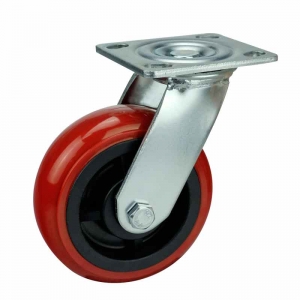
An industrial caster is defined more by engineered duty than by appearance. It normally uses a bracket, axle, wheel core, tread, bearing, swivel race and mounting sized for repeated workplace use. The design may prioritize impact strength, low rolling resistance, corrosion resistance, hygiene, temperature capability, noise or steering stability. A thick bracket alone does not prove that a caster is suitable.
Load rating is necessary but incomplete. A cart parked in one position creates mainly static stress; a manually pushed cart adds acceleration, turning and obstacles; a tow-line cart adds speed, distance and heat; a drop-loaded fixture adds shock. The same maximum weight can therefore require different industrial casters. The quoted rating must be read with its speed, floor and duty assumptions.
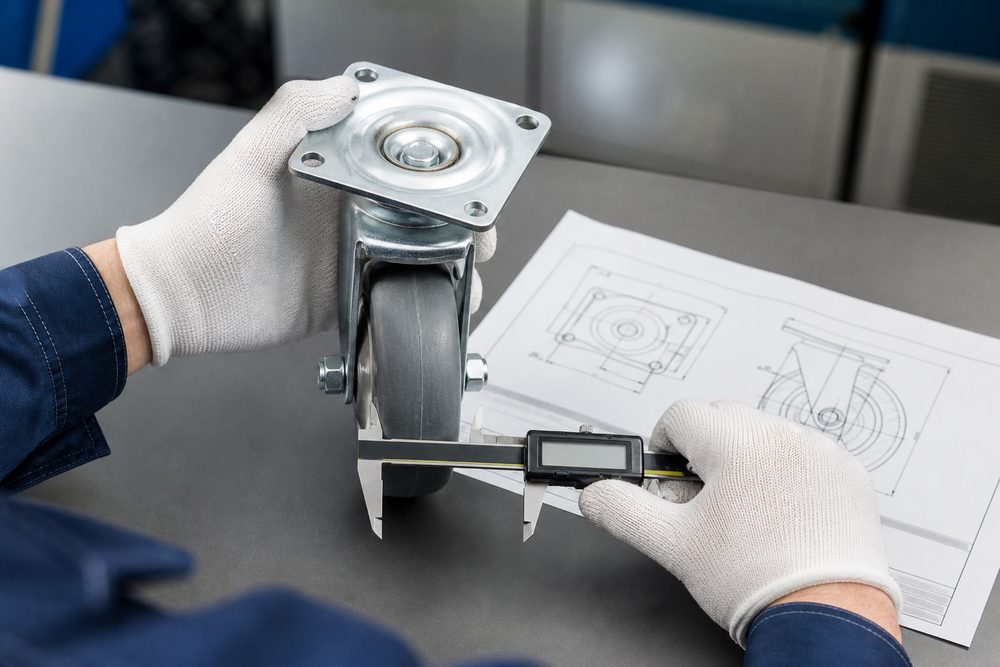
Industrial caster dimensions are functional interfaces. Wheel diameter and width affect obstacle crossing, contact pressure and envelope. Overall height affects equipment level. Swivel offset and radius affect steering and clearance. Plate size, bolt pattern and stem dimensions determine whether load reaches the frame safely. Drawings should be approved before samples or production.
The complete vehicle also matters. A rigid frame distributes load more consistently than a twisted platform. Payload location changes corner forces. Handle height changes operator leverage. Caster layout determines tracking. Industrial selection is therefore a collaboration between equipment designer, operator, buyer and caster supplier.
Industrial Caster Materials and Environments
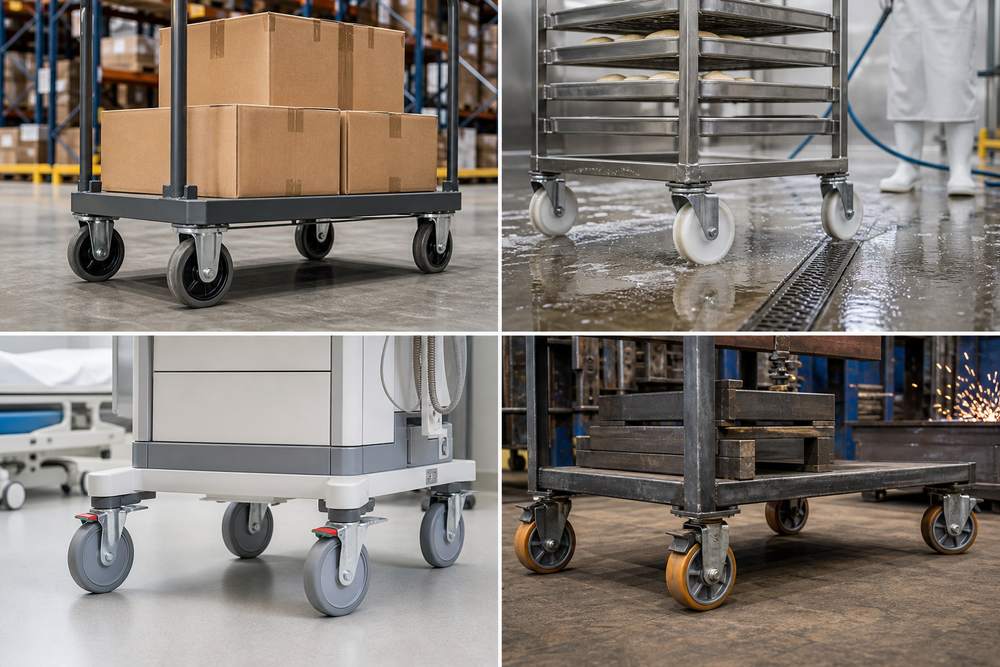
Polyurethane is common on industrial carts because suitable formulations can combine capacity, wear and floor protection. The tread may be bonded to polymer, aluminum or iron cores. Rubber and TPR reduce noise and vibration. Nylon or polypropylene can offer easy cleaning and chemical resistance. Phenolic, cast-iron and steel wheels suit selected hard-duty or temperature conditions where noise and floor impact are acceptable.
Corrosive or washdown areas need more than a stainless fork. Review axle, bearing, balls, grease, brake parts, fasteners, core and tread. Cleaning chemicals, concentration, temperature and contact time should be documented. Sealed components reduce contamination ingress, but a seal does not automatically certify hygienic design or pressure-wash capability.
Heat changes tread hardness, bond strength, grease and bearing life. Cold can reduce resilience or increase brittleness. Dust and fibers can wrap around axles or enter races. Outdoor routes add water, ultraviolet exposure and uneven ground. Each environment should be converted into a temperature range, chemical list, cleaning method and obstacle description.
Noise, vibration and floor preservation have economic value. A low-priced hard wheel may damage epoxy, disturb staff or shake sensitive assemblies. A very soft wheel can raise push force and labor cost. The industrial solution balances equipment uptime, operator safety, floor life, noise and replacement cost.
Where Industrial Casters Are Used
Warehouse applications include picking carts, dollies, racks, platform trucks and maintenance equipment. Manufacturing uses mobile fixtures, welding tables, die carts, line-side trolleys and workstations. Food and pharmaceutical environments add washdown and contamination control. Medical equipment adds quiet mobility, precise control and cleaning. Each sector needs its own measurable acceptance criteria.
OEM machinery may use casters only during installation or service. In that case static capacity, leveling and stability can matter more than long travel. Mobile robots and powered carts create the opposite situation: repeated travel, speed, heat and steering dynamics dominate. Calling both products “machine casters” hides the engineering difference.
Heavy and super-heavy industrial casters support high-load platforms, aerospace tooling, molds, dies and large machinery. These applications demand controlled load distribution, strong mountings and careful floor review. The load range alone does not define heavy duty; shock, speed, wheel material, bracket construction and test method remain critical.
Export buyers should connect caster choice to spare-parts strategy. Record the approved model and revision, keep dimensioned drawings, identify interchangeable wear parts and define inspection intervals. A technically correct first order creates little value if replacement identity is lost two years later.
Practical Case: Standardizing Casters Across an Assembly Plant
A plant operates 40 cart designs with many unrecorded caster replacements. Downtime and purchasing complexity are rising, but choosing one universal caster would ignore loads from 120 kg to 1,100 kg, washdown areas, long aisles and compact cells. The team groups carts by duty rather than visual similarity.
Three validated families are created: a quiet maneuverable light/medium platform, a tracking-focused industrial PU platform, and a corrosion-resistant washdown platform. Each family defines capacity calculation, wheel diameter, mounting, bearing, brake, route and inspection. High-load and powered-tow carts remain separate because their risk and validation needs are different.
The project reduces SKUs while preserving application fit. The plant measures caster-related downtime, push complaints, replacement frequency and total landed cost. Standardization becomes an operating system, not merely a bulk-price negotiation.
Engineer Experience
Before approving an industrial caster, write a one-page duty profile that a supplier can test against. If the profile lacks maximum load, speed, distance, floor and environment, the quotation cannot be technically comparable.
Separate component failure from system failure. Repeated fork bending may reflect shock or an undersized bracket, but loose plates can reflect frame flex or incorrect fastener torque. Preserve failed parts, lot identity and operating details for root-cause review.
Use pilot quantities for high-risk equipment. A catalog rating can screen candidates; only a loaded route trial shows operator effort, noise, tracking, brake access and obstacle behavior in the actual plant.
Factory Testing and Quality Context
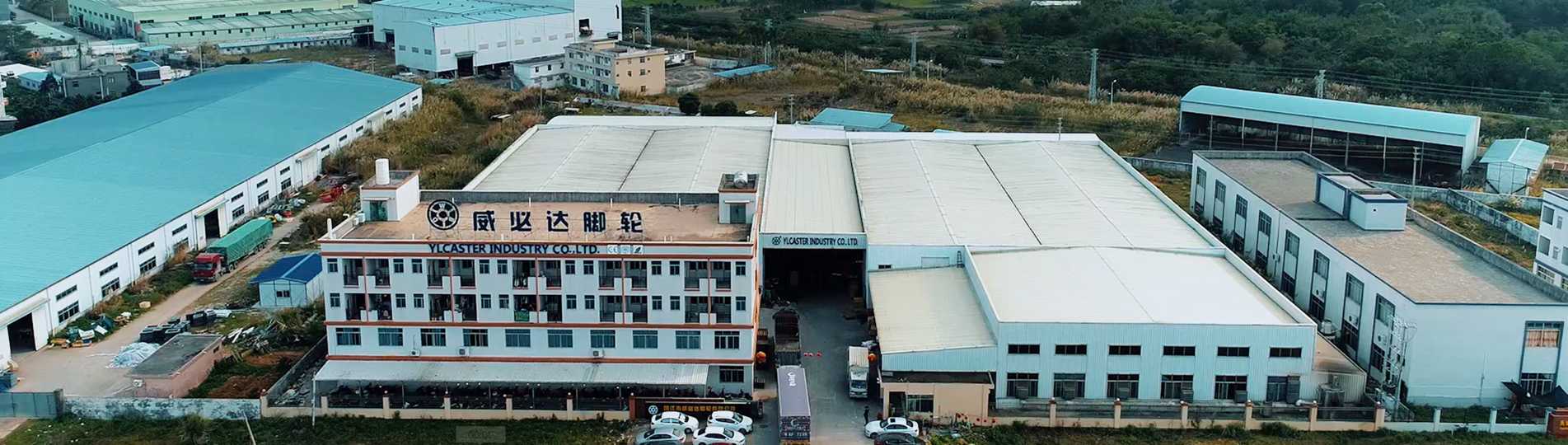
YLCASTER was established in 1997. Its 2025 company profile reports a 40,000 m² facility, about 200 employees and more than 2,000 caster items, with a company-level portfolio from 10 kg to 30 tons. It lists CE, RoHS and ISO 9001 credentials. These facts support supplier evaluation but do not automatically qualify every model for every industry.
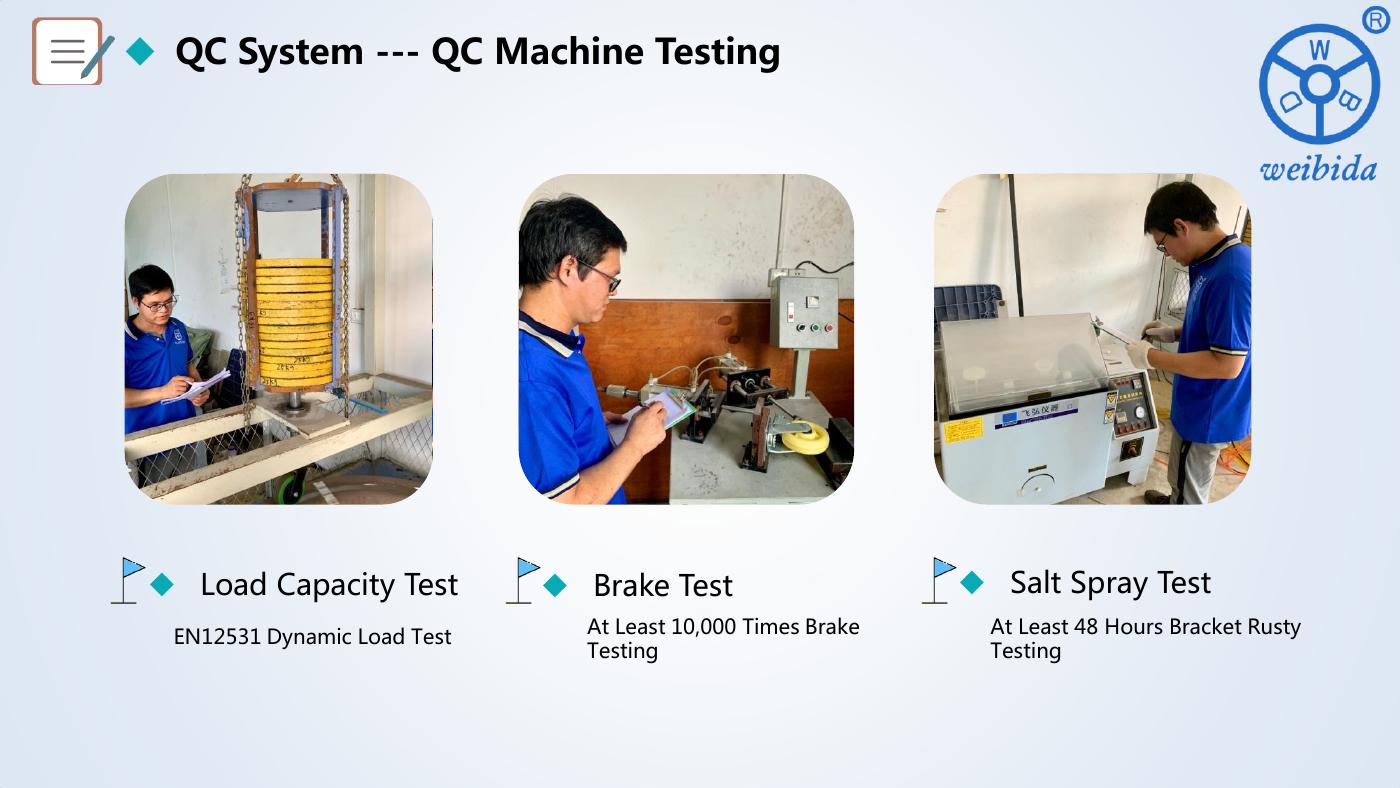
Factory materials reference EN 12531 dynamic-load testing, at least 10,000 brake cycles and salt-spray testing of at least 48 hours. Buyers should convert their application risks into a test and inspection plan: dimensions, materials, capacity, rolling, swivel, brake, corrosion, appearance, labels and packaging, with acceptance criteria agreed before production.
International Purchasing Notes
For international sourcing, evaluate total landed and operating cost. Include unit price, tooling, samples, testing, freight, tariffs, inventory, replacement lead time, push labor, floor damage and downtime. A caster that costs slightly more but lasts longer and reduces operator effort can produce the better business return.
Document market-specific needs for Germany, Russia, Brazil, Korea, Kenya, Colombia, Saudi Arabia and Peru, as well as wider Europe, Asia, Southeast Asia and South America. Climate, language, conformity, packaging and customs requirements can change. The importer should confirm current rules; the caster RFQ should record the resulting specification.
FAQ
What is an industrial caster?
It is a complete wheel-and-mounting assembly selected for measurable workplace load, movement, floor, environment, control and duty requirements.
Are all industrial casters heavy duty?
No. Industrial casters cover light, medium, heavy and specialized duties. The exact model rating and test conditions define capability.
Which wheel material is common for industrial carts?
Polyurethane is common, but rubber/TPR, nylon, phenolic, iron, steel and specialized materials may be better for particular needs.
How do I calculate industrial caster capacity?
Add equipment and maximum payload. For four casters, divide by three as an uneven-load screen, then account for shock, speed and duty.
What is the best industrial caster layout?
Two swivel plus two rigid often tracks well; four swivel turns tightly. Cart geometry, route and operating method determine the best layout.
Can industrial casters be used outdoors?
Only when the wheel, bearing, bracket, finish and brake suit water, ultraviolet exposure, temperature, debris and rough ground.
How often should industrial casters be inspected?
Set frequency from risk and duty. Check tread, bearings, swivel, axle, brake, mounting fasteners, frame and push force.
What should an industrial caster supplier provide?
Expect a controlled drawing, model-specific rating, material and test information, sample process, quality plan, packaging details and change control.
Recommended Products
- Industrial caster products: Browse caster families for manufacturing, warehouse and OEM equipment.
- American heavy-duty caster family: Review welded industrial constructions and wheel options.
- Food-processing caster resources: Explore application options for wet or hygienic areas.
Related Articles
- Casters For Warehouse Trolleys
- Casters For Food Processing Equipment
- OEM Caster Manufacturer Guide
- How Casters Are Tested
Request a Quote
Technical note: company-level factory figures describe YLCASTER’s overall portfolio, not every individual model. Confirm the selected caster drawing, test conditions, rated capacity and compliance requirements before purchase.