


Published: August 28, 2026 | Updated: August 31, 2026
Swivel vs Rigid Casters
Direct Answer
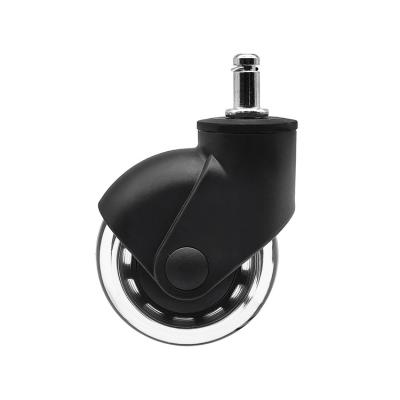
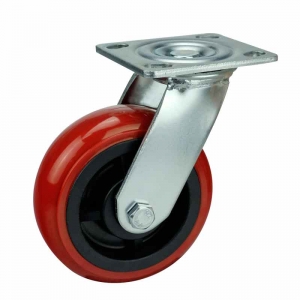
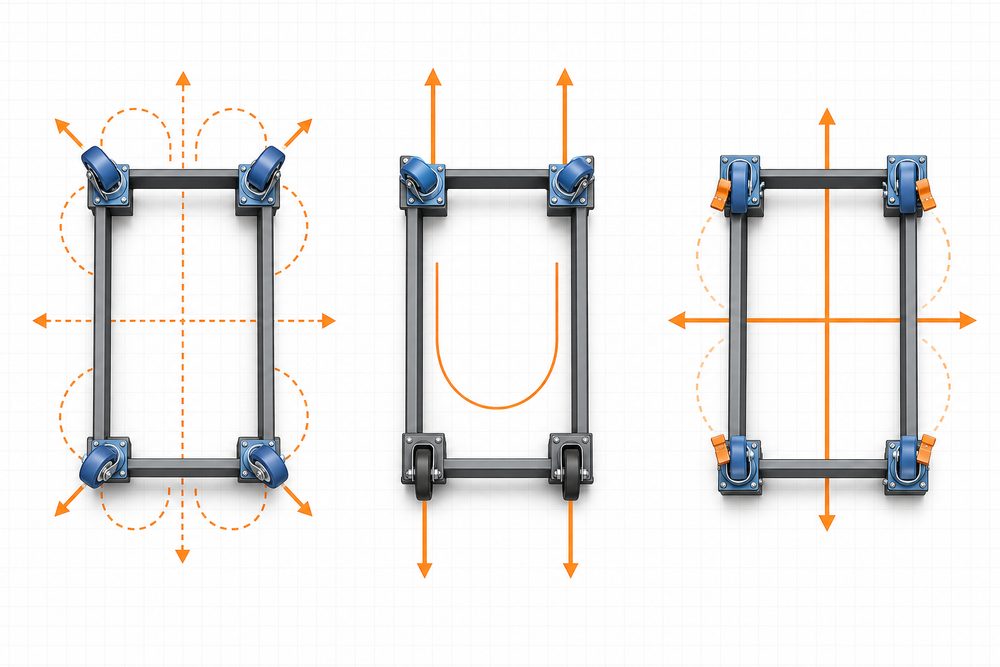
Swivel casters turn around a vertical axis, allowing equipment to change direction and maneuver in tight areas. Rigid casters hold a fixed wheel direction, so they roll forward and backward and help a cart track in a straight line. Four swivel casters provide maximum maneuverability but can wander on long routes. Two swivel plus two rigid casters are easier to control in aisles but cannot move sideways. Directional locks let selected swivel casters act rigid when required. The right layout depends on cart length, center of gravity, operator position, aisle geometry, travel distance, speed, floor, towing and parking needs—not simply which caster carries more load.
Quick Reference Data Table
| Layout | Main advantage | Main limitation |
|---|---|---|
| Four swivel | Turns in a small envelope and can reposition in crowded areas. | May wander or fishtail over long straight routes. |
| Two swivel + two rigid | Predictable steering and straight tracking. | Larger turning circle and no true sideways movement. |
| Four swivel + directional locks | Changes between maneuvering and tracking modes. | More components and operating discipline required. |
| Two swivel + two rigid + brakes | Common manual-cart control and parking arrangement. | Brake location must remain accessible under load. |
| Six-wheel center rigid | Can help long platforms pivot around a central pair. | Requires engineered load sharing and floor contact. |
| Diamond caster layout | Tight turning for some specialized equipment. | Stability and corner load transfer need careful review. |
| All rigid | Very efficient straight movement in guided systems. | Cannot steer without another guiding mechanism. |
| Powered-tow layout | Optimized for tow direction, speed and heat. | Manual caster assumptions may not be valid. |
How Swivel Casters Steer
A swivel caster’s wheel axle is offset from its vertical swivel axis. When the cart moves, friction at the contact patch creates a trailing action that rotates the fork until the wheel follows the direction of travel. The relationship between offset, wheel diameter, load, tread and swivel bearing affects steering response. More offset can reduce swivel force but increases swivel radius and side loading.
A loaded swivel caster does not instantly point in the desired direction. At startup, some casters may face backward and must rotate through a scrub movement. On four-swivel carts this can create high initial effort, especially with wide or soft treads. Handle placement and operator technique influence the result, so testing should begin from unfavorable caster orientations rather than only after the wheels are aligned.
Shimmy is rapid unwanted swivel oscillation. It can be influenced by speed, excessive play, wheel imbalance, offset, tread condition, mounting deflection and layout. Replacing a caster with the same diameter but different geometry can introduce instability. Powered applications require a model and configuration approved for the actual travel speed.
Swivel locks and directional locks are control devices, not capacity upgrades. A directional lock holds the heading but still lets the wheel roll. A total-lock brake is intended to restrict both rolling and swiveling for parking. The operator must be able to see or feel the mode and engage it without reaching into hazards.
How Rigid Casters Improve Tracking
A rigid caster’s fork does not rotate around a vertical axis, so the wheel establishes a stable direction. Two rigid casters create a directional reference for the trolley, which reduces constant steering corrections. This is valuable for long platforms, narrow aisles, ramps and frequent straight travel.
Rigid casters still need clearance and frame alignment. If two rigid casters are not parallel, their wheels scrub against each other and increase push force. A flexible or distorted frame can cause the same effect under load. Use dimensioned mounting references, flat plates and controlled welding or bolting so the rolling axes remain aligned.
Position matters. On a conventional four-caster cart, rigid casters at one end and swivel casters at the handle end give familiar steering. If the operator pushes from either end, the fixed end may become difficult to control. Center-rigid or six-wheel layouts can improve pivoting for long carts, but rocking, threshold contact and changing wheel loads must be evaluated.
Rigid casters are not automatically stronger than swivel casters. Capacity depends on the exact wheel, axle, fork, mounting and test. Rigid brackets have fewer steering components and can be structurally efficient, but buyers should compare published model ratings rather than assume performance from type.
Choosing the Layout from the Route
Map the route before choosing hardware. Record aisle width, turn angles, door thresholds, elevator gaps, slopes, docking positions and distance per trip. Note whether the cart is pushed, pulled, moved from both ends or towed. A layout that excels in a compact cell may be exhausting during a 200-meter warehouse journey.
Then evaluate load and center of gravity. Tall or uneven loads increase overturning and steering risk. Keep the caster footprint wide enough, mount the strongest control casters where operators can use them, and prevent the payload from shifting. On slopes, a parking brake is not necessarily a service brake; define the required holding test and operating procedure.
Prototype with the real mass, worst floor and representative operators. Measure starting force, sustained push force, turning space and stop/hold behavior. Observe caster reversal, wheel scrub, cart drift and hand position. The best layout is the one that reduces total operating risk and labor, not the one with the smallest purchase price.
For repeated OEM builds, lock the approved layout in the equipment drawing. Record caster model, mounting, orientation, torque, brake and directional-lock locations. Change control should require a review of vehicle behavior, because a seemingly minor change in offset or tread can alter steering.
Practical Case: A 900 kg Long-Aisle Material Trolley
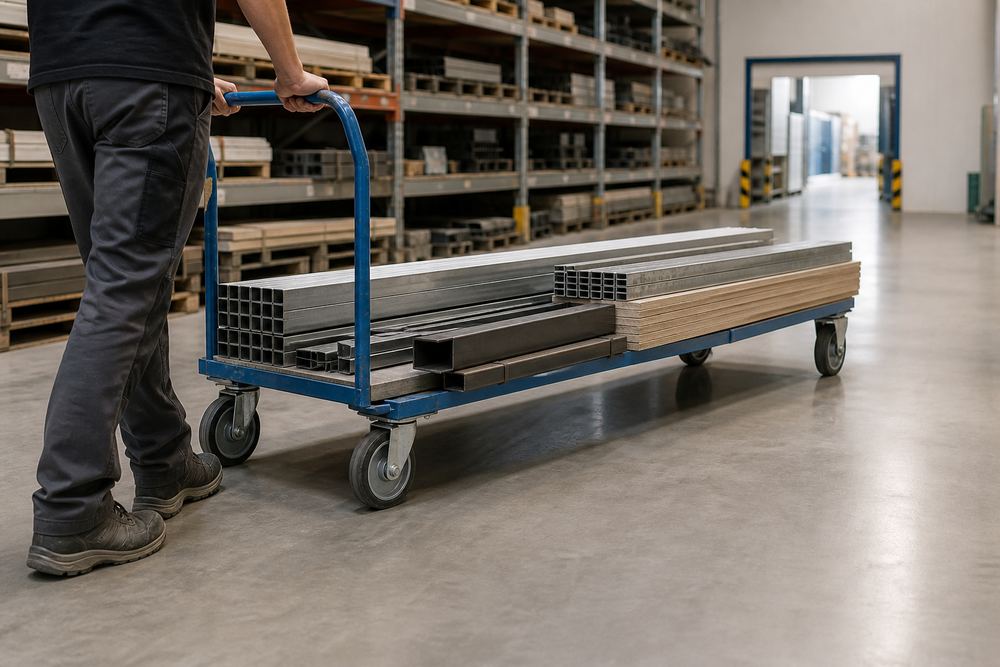
A 2.4-meter trolley carries 650 kg of parts plus a 250 kg frame. Four swivel casters were initially proposed because the cart must position at workstations. Trial operators report wandering and frequent steering corrections over a 120-meter route. Load screening uses 900 kg divided by three, or 300 kg per caster before additional dynamic allowance and model-specific verification.
The team compares two swivel plus two rigid casters against four swivel casters with directional locks. The two-and-two layout tracks best but needs more turning space at the stations. Directional locks preserve maneuverability in the cells and create a straight-running mode for the aisle. The final choice is made from a loaded route trial, not a catalog assumption.
The approved solution documents the lock direction, operator sequence, plate orientation and inspection points. The business result is lower steering effort, fewer collisions and a repeatable specification for future trolleys.
Engineer Experience
When a trolley is difficult to push, do not immediately choose a larger motor or stronger operator. First separate rolling resistance from steering resistance. Misaligned rigid casters, reversed swivel casters, soft tread deformation and frame twist need different fixes.
Place controls where they support the work sequence. A brake or directional lock that is hidden under the frame will not be used consistently. Check pedal clearance with the wheel swiveled through its full envelope and with operators wearing required footwear.
If a cart is occasionally towed, treat towing as a separate operating mode. Speed, distance, cornering, heat and shock can exceed manual conditions. Obtain written approval for the exact caster and validate the complete vehicle.
Factory Testing and Quality Context
YLCASTER’s 2025 profile reports a 40,000 m² factory, about 200 employees and more than 2,000 items across a 10 kg to 30 ton company-level range. Established in 1997, the manufacturer supplies swivel, rigid, brake and application-specific caster families. Buyers should use this portfolio breadth to compare layouts while still requiring model-specific drawings and ratings.
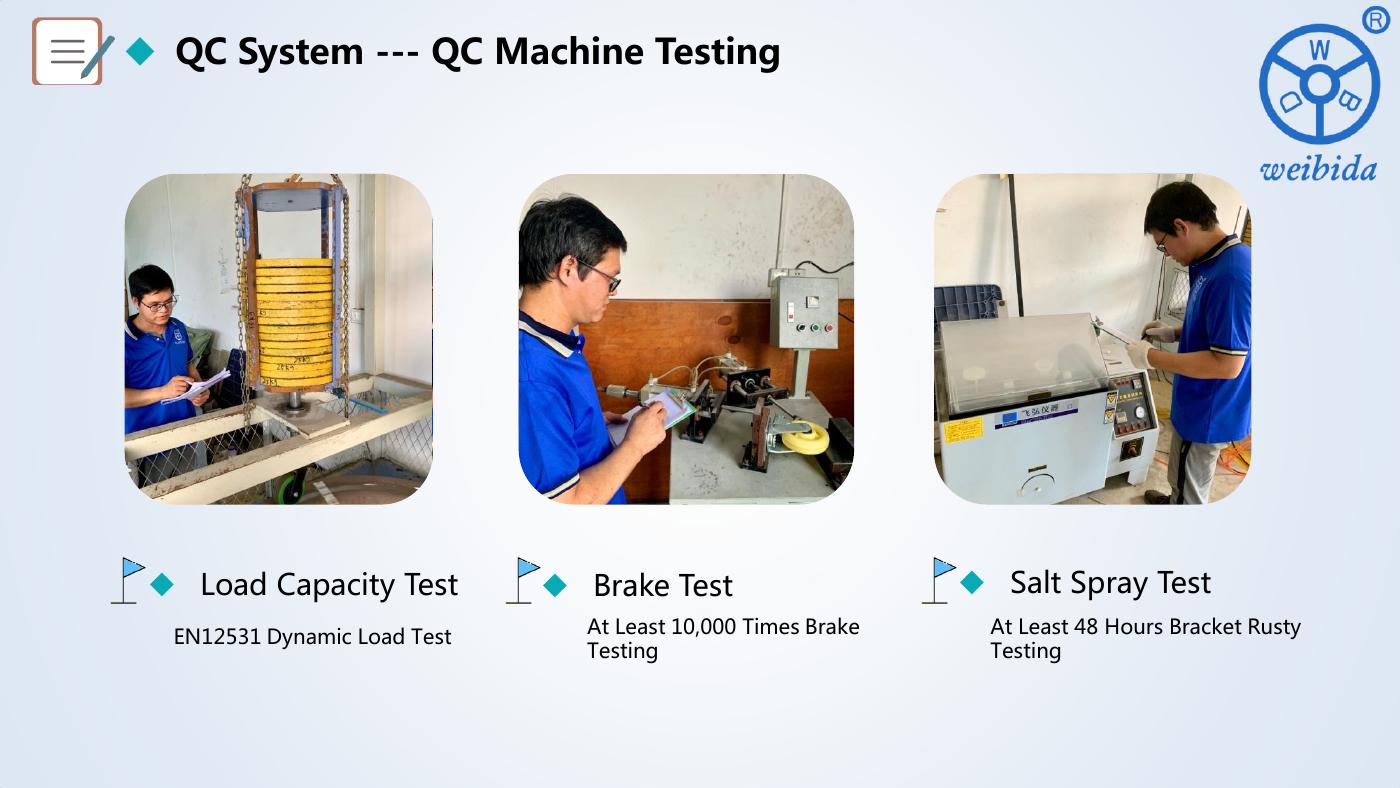
Factory capability statements include EN 12531 dynamic-load testing, brake-cycle testing of at least 10,000 cycles and salt-spray testing of at least 48 hours. For swivel-versus-rigid decisions, testing should also cover the complete cart behavior: caster reversal, straight tracking, turn effort, braking and fastener retention on the representative floor.
International Purchasing Notes
Export RFQs should show the caster layout on the equipment drawing, including which positions swivel, remain rigid, carry brakes or use directional locks. State the normal direction of travel and operator handle. This eliminates a common problem in which correct individual casters are installed in the wrong orientation.
Packaging must keep brakes and forks from damaging adjacent casters during long shipping. For markets such as Germany, Brazil, Korea, Saudi Arabia, Kenya, Colombia, Peru and Russia, confirm labels, documents, environmental limits and current importer requirements. Commercial comparison should include landed cost, replacement availability and expected service interval.
FAQ
Are swivel casters harder to push than rigid casters?
They can require more steering and reversal force, especially from an unfavorable orientation. Rigid casters generally track more efficiently in a straight line.
Can four swivel casters move sideways?
A cart with four swivels can reposition laterally through coordinated caster rotation, although initial wheel reversal and scrub may require effort.
What is the best caster layout for a trolley?
Two swivel plus two rigid is common for straight routes; four swivel suits tight spaces. Directional locks can combine both behaviors.
Should swivel casters be at the handle end?
Often yes for familiar steering, but route, push direction, load and access determine the best position. Test the real cart.
Do rigid casters carry more weight?
Not automatically. Capacity depends on the exact wheel, axle, bracket, mounting and test conditions.
What is a directional-lock caster?
It is a swivel caster that can be locked into a chosen heading so it behaves like a rigid caster while the wheel still rolls.
Why does a four-swivel cart wander?
All casters can change heading, so floor slope, load position and small steering inputs may cause drift. Wear or shimmy can make it worse.
Can casters be used for powered towing?
Only when the specific model and layout are approved for the tow speed, distance, heat, shock and turning duty.
Recommended Products
- Industrial caster catalog: Compare swivel, rigid, brake and mounting configurations.
- American heavy-duty casters: Review robust swivel and rigid options for industrial trolleys.
- Heavy-duty red caster example: See a model page and specification format.
Related Articles
- Casters For Warehouse Trolleys
- Heavy Duty Caster Buying Guide
- How Casters Are Tested
- OEM Caster Manufacturer Guide
Request a Quote
Technical note: company-level factory figures describe YLCASTER’s overall portfolio, not every individual model. Confirm the selected caster drawing, test conditions, rated capacity and compliance requirements before purchase.